.png)
SUMMARY
Stroked is a camera-based, AI-driven physical therapy application designed to empower stroke survivors to maintain consistent, correctly form-checked rehabilitation at home. Built to bridge the critical gap between supervised clinical rehab and unguided home recovery, Stroked leverages real-time computer vision motion-tracking to provide automatic rep counting, visual feedback, and progressive skill-tree recovery paths tailored for users with motor impairments.
Role: Lead UI/UX Designer & Creator (personal project)
Platform: Web app, camera-based motion tracking
Tools: Lovable, Figma
Live product: stroked.app
.png)
The Core Challenge: Following hospital discharge, stroke patients must complete hundreds of daily repetition exercises to rebuild neural pathways (neuroplasticity). However, over 70% of home therapy fails due to lack of real-time movement correction, loss of motivation, and fatigue. Clinical physical therapy provides guidance, but home practice leaves patients entirely unassisted.
Design Objective:
Create an accessible, low-friction digital physical therapist that tracks joint movement via standard device cameras, provides instantaneous rep verification, and gamifies long-term motor skill recovery without overwhelming users experiencing cognitive or physical exhaustion.
Problem framing
To design an experience that addresses the full spectrum of post-stroke recovery, the research methodology combined deep lived experience with external user validation across distinct motor impairment profiles.
Severe hemiplegia / low fine motor skill
Moderate motor control / isolated movement
Functional motor regain / daily tasks
Problem framing
1. The Clinical Continuity Gap: Patients lose motivation and confidence immediately after formal clinical therapy sessions end because they fear performing exercises incorrectly or causing injury.
2. Visual & Cognitive Friction: Complex dashboards with dense text increase fatigue. Stroke survivors need direct, single-action focus states.
3. Calibration Jitter: Standard motion-tracking tools fail for stroke patients because shaky or partial movements trigger false rejections or missed reps, leading to severe user frustration.
goals
From that experience, I set out to design something that could give people doing solo rehab outside of a clinical setting:
1. A clear, structured plan of exercises organized by body area;
2. Real-time feedback on whether a movement was performed correctly, without needing a therapist in the room;
3. Enough structure and small wins to keep someone motivated to practice daily, since consistency is what drives recovery.
Design approach
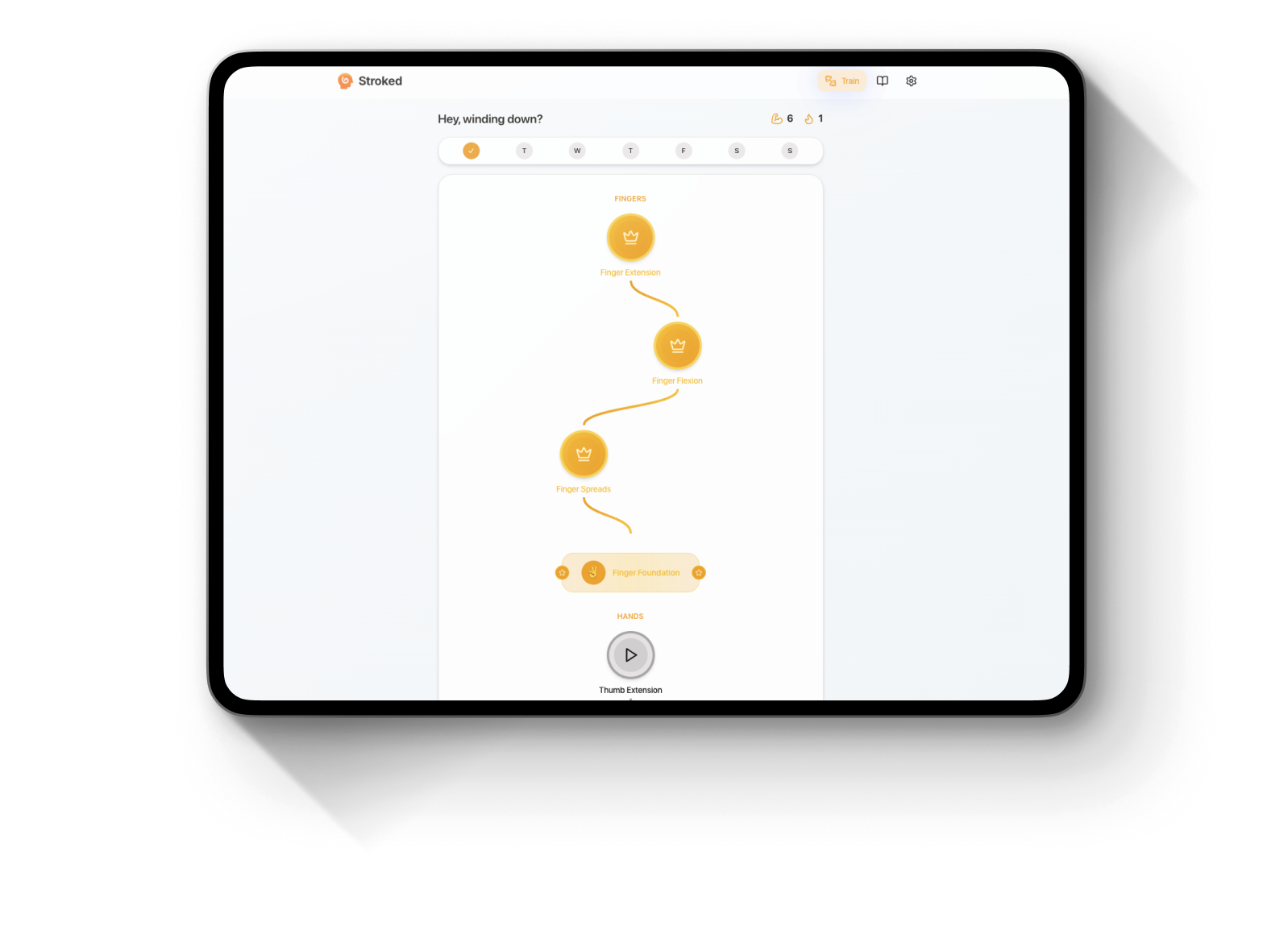
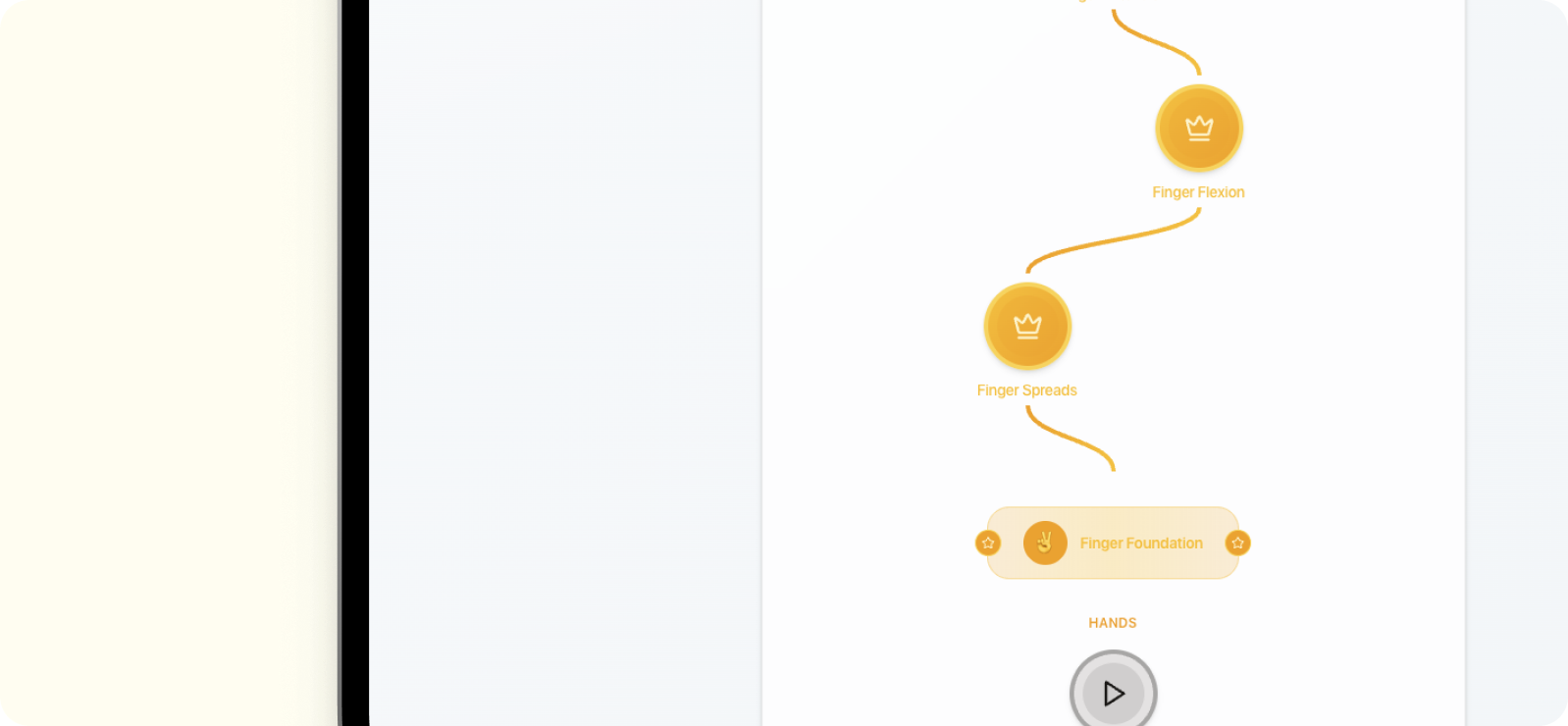
Structuring the exercise plan. Rather than presenting exercises as a flat list or a dashboard, I organized them into a progressive skill-tree structure grouped by body region — fingers, hands, arms, shoulders, core, legs, full body, and daily tasks (like lifting a cup or holding a spoon). This mirrors how physical rehabilitation actually progresses, from small isolated movements toward functional, real-world tasks, and gives users a visible sense of progression rather than an undifferentiated exercise list.
Camera-based feedback.Each exercise uses the device camera to track the joints relevant to that movement, based on a setting for which side of the body is affected. Visual feedback (the exercise border glows, then flashes once a rep is counted) gives the user a clear, low-effort signal of correct completion, standing in for the correction and rep-counting a therapist would normally provide. I designed and built this using Lovable, which let me move quickly from concept to a working, testable product as a solo designer.
.png)
Motivation and consistency. Recovery is driven by repetition over time, not any single session, so I designed a weekly practice structure with a visible progress bar and a streak counter, plus a badge system tied to completing each body-area category (e.g., "Finger Foundation," "Hand Mastery," "Full Recovery Champion"). This borrows gamification patterns from habit-building apps to make daily practice feel rewarding rather than clinical.
Accessibility as a core requirement. Because the target users often have reduced fine motor control, fatigue, or visual strain, I built adjustable tracking sensitivity (low/medium/high) to accommodate different ranges of motion, along with large text, high-contrast, and reduced-motion display settings.
testing
I tested the app on myself throughout development, as both designer and end user, and with a stroke survivor I connected with through social media, which gave me a second, independent perspective on whether the exercises, tracking, and feedback worked for someone with a different recovery profile than my own.
The product underwent testing across two primary evaluation channels: self-testing during personal rehab recovery and external validation with stroke survivors recruited via targeted Google Ads campaigns.
challenges
Reaching a rehabilitation center regularly is often difficult for stroke survivors, whether due to travel time, mobility limitations, or logistics, which reduces how often people can get supervised practice. On top of that, sustaining the consistency and energy needed for daily rehab is hard without external structure or accountability, especially once formal therapy sessions end.
On the technical side, tuning the camera's tracking sensitivity was a real challenge, since it needed to work reliably for people with limited, shaky, or partial movement, not just able-bodied test users, which is a very different calibration problem than typical motion-tracking use cases.
Outcome / impact
I recruited beta testers through Google Ads to validate the app with real users outside my own immediate circle.
Since launching, 495 users have completed onboarding, providing information on their affected side, recovery goals, and the reason for seeking rehabilitation (most commonly stroke, alongside some post-surgery and chronic pain cases). This gave me real signal beyond my own recovery and the one stroke survivor I tested with directly, showing the exercise structure and tracking approach resonate with a broader range of recovery situations than just my own.